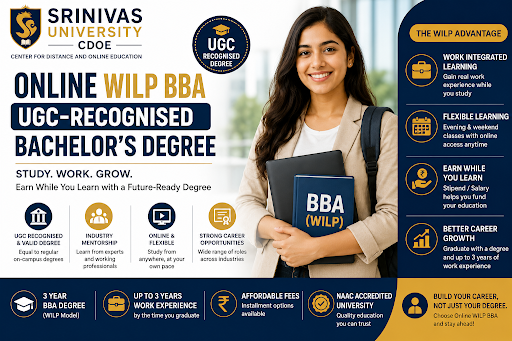
The Diary, Decoded: Five Pillars of the WILP Model
Pillar 1: Work Is Part of the Programme, Not a Break From It
Ananya's Monday is not truancy; it is curriculum. In a WILP, the professional engagement arranged through the programme's industry partners or through the student's own employment is a formal component of the learning design. This is the model's foundation: the workplace becomes the second classroom, supplying the context, problems, and stakes that lecture halls cannot manufacture.
Pillar 2: Academics Engineered Around Working Hours
The Wednesday-evening and Saturday classes are the second pillar: live online sessions scheduled outside office hours, recorded lectures for revision on the student's own clock, and a digital learning platform carrying materials, discussions, and submissions. The academic rigour of a BBA in accounting, marketing, statistics, economics, organisational behaviour, and business law remains intact; only the delivery bends around a working life.
Pillar 3: Assignments With a Real Address
Ananya's semester project analyses her own employer's bottlenecks, the third pillar, and pedagogically the most powerful. WILP assessment leans on applied work: projects, case analyses, and reports rooted in the student's actual organisation. Theory tested on a live business is retained differently, and every completed assignment doubles as a portfolio artefact with a manager who witnessed it.
Pillar 4: Mentors From the Field
The Saturday mentorship call is the fourth pillar: alongside faculty, WILPs attach industry mentors practising managers who review projects, translate classroom concepts into trade reality, and quietly become the first nodes of the student's professional network. Three years of such contact leaves a graduate with references most freshers spend years accumulating.
Pillar 5: Earning While Learning
And Sunday's detail that the stipend covers the fee instalment is the fifth pillar: WILP students typically earn throughout the programme, whether as stipendiary trainees or salaried employees. The financial mathematics of a degree inverts: instead of three years of pure cost, the programme part-funds itself, and for many students fully funds itself a difference that changes who can afford quality business education at all.
The Twin Odometer Principle
Compress the five pillars into one image in this article's framework and you get the Twin Odometer Principle. Every student's career runs two odometers: a Credit Odometer (academic progress toward the degree) and an Experience Odometer (verified months of professional work). A conventional student runs them in sequence: three years on the first dial, zero on the second, then starts the second from scratch after convocation. A WILP student runs both simultaneously: at graduation, the Credit Odometer reads “degree complete”, and the Experience Odometer reads up to thirty-six months. Recruiters read the second dial first. That single difference, both dials moving at once, explains every career advantage in the sections that follow.
Is It Real? Validity, Recognition and the Rulebook
The legitimacy question deserves a direct answer, because it is the first one parents ask. Work-integrated and online BBA programmes offered by UGC-recognised universities through their entitled online/distance education arms award degrees with the same legal validity as campus degrees, valid for private-sector employment, government job eligibility (subject to each recruitment's own criteria), postgraduate admission including MBA, and professional examinations. India's National Education Policy has pushed explicitly in this direction: apprenticeship-embedded and work-integrated degrees, credit for internships and on-the-job training, and fully recognised online delivery are now stated national objectives, not grey areas. The practical checklist before enrolling anywhere: confirm the university's UGC recognition and online/ODL entitlement (verifiable on the UGC-DEB portal), its NAAC accreditation status, and the transparency of its fee and work-arrangement structure. A programme that clears those three checks is as “real” as any degree in the country.
Want to verify a live example against that checklist? Review the structure, eligibility, and recognition details of this Online BBA (Hons) programme page.
WILP BBA vs Regular BBA: The Honest Comparison
| Dimension | Regular (Campus) BBA | WILP BBA |
|---|---|---|
| Weekly rhythm | Full-time classes; work optional/summer | Work through the week; classes evenings, weekends, online |
| Experience at graduation | Internships (2–6 months typical) | Up to 36 months of verified work history |
| Learning style | Theory first, application later | Theory and application in the same week |
| Cost economics | Full fees + living costs; no income | Fees offset (often fully) by stipend or salary |
| Campus life | Full clubs, fests, peer immersion | Limited; professional network replaces campus network |
| Discipline demanded | Structured by timetable | High self-management across job + study |
| Graduate identity | Fresher with a degree | Professional with a degree and a track record |
| Best suited for | Students wanting immersive campus years | Career-focused students, working learners, cost-conscious families |
Read the table without romance: neither model is universally superior. The campus route buys immersion and unstructured youth; the WILP route buys a head start and financial sanity. The right question is not “which is better?” but “which dial matters more to this particular student's next five years?” and for students whose answer is employability, the WILP's twin odometers are difficult to argue against.
What the Double Dial Buys: Careers After a WILP BBA
Now the career payoff is the reason this model exists. Because a WILP graduate interviews with a résumé that already contains employers, projects, and references, they compete in a different bracket from day one. The advantages, itemised:
- Skipping the fresher queue: many WILP graduates are absorbed by their training organisation itself, or move laterally on the strength of a manager's reference, bypassing cold applications entirely.
- Interviewing with evidence: every behavioural question (“tell me about a time…”) meets a true story from a real workplace.
- Faster first promotions: employers routinely count WILP work history toward seniority, compressing the trainee years.
- Clearer specialisation: three years inside a business reveals whether sales, HR, operations, or finance is the student's lane before the postgraduate money is spent.
- A funded runway to the MBA: graduates hold exactly what good MBA admissions and employers prize: a valid bachelor's plus genuine work experience, often debt-free.
The roles WILP BBA graduates most commonly step into: Business Development Executive, Sales & Marketing Executive, HR Executive / Talent Acquisition Associate, Operations Executive, Retail & Store Management Trainee, Banking & Financial Services Sales Officer, Digital Marketing Associate, Customer Success Associate, Supply Chain & Logistics Executive, and Management Trainee tracks with entry compensation typically in the ₹2.5–4.5 lakh per annum band, and experienced-hire treatment (₹4–6 lakh and accelerated bands) common for graduates whose work history matches the role. Within three to five years, team-lead and assistant-manager positions at ₹6–10 lakh are the realistic trajectory reached faster than the conventional path precisely because the experience odometer started early.
Who Should Choose It and Who Shouldn't
Honesty clause. The WILP fits: students who know they want a business career and prefer momentum to campus immersion; working young people and family-business successors who cannot pause income for three years; cost-conscious households for whom self-funding education changes everything; and disciplined self-managers because running a job and a degree simultaneously is genuinely demanding. It fits poorly: students seeking the full residential campus experience, those targeting careers that specifically prize campus placement pipelines, and anyone not yet ready for workplace accountability at eighteen. Choosing with self-knowledge is the whole game; the model is a tool, not a verdict.
The Money Question, Answered Plainly
Fee structures vary by university and programme design, but the honest market picture is this: online and work-integrated BBA programmes in India typically cost a fraction of private campus BBAs, commonly in the range of a few tens of thousands of rupees per semester, payable in instalments while the stipend or salary earned through the work component runs in parallel. For many students the net cost of the degree approaches zero or turns positive; for nearly all, it eliminates education debt. Exact, current fee schedules should always be taken from the official programme page rather than third-party listings and weighed not against other courses' fees, but against the three years of income and experience the model adds to the same calendar.
For current fees, eligibility, and the admission calendar, see the official Online BBA (Hons) page directly.
The Short Verdict
A Work Integrated Learning Program for BBA students is the degree rebuilt around a simple observation: the job market pays for proof, and proof is manufactured by doing. By running the credit odometer and the experience odometer on the same three years with recognised academics, workplace assignments, industry mentors, and an income stream, the WILP graduates a professional where the old model graduated an applicant. It demands discipline and trades away campus romance; in exchange, it hands a twenty-one-year-old what most twenty-four-year-olds are still chasing: a valid degree, a working network, savings instead of debt, and a résumé that answers the experience question before it is asked.